Back in county fair season (the date on the photo says September 13) we went to the Oxford County fair. I saw a yarn-handling device labelled “squirrel cage swift” — think two hamster exercise wheels with a skein of yarn around the two of them. It takes up lots less space than an umbrella swift but serves the same purpose.
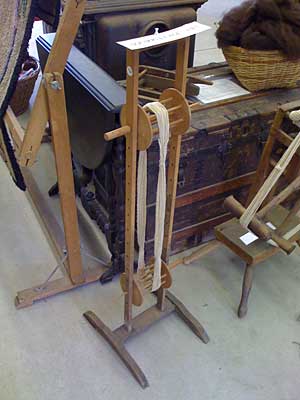
I decided to make one.
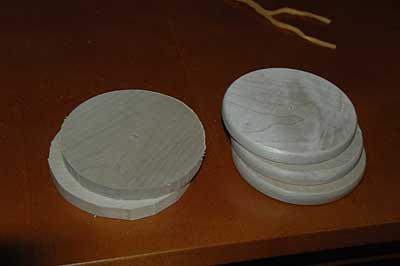
I bought some maple lumber at Lowe’s in Portland a few weeks ago. Last weekend I cut out five five-inch circles (I only need four for the project, but the board was big enough for five) on my bandsaw. This weekend I put them (one at a time, natch) on the faceplate of the Jet Mini lathe, turned them down to really round, and sanded them. Here’s halfway in the process, two still the bandsaw product and three looking well sanded — and I mean well sanded. I was amazed at how good they look:
That’s all for now — maybe next weekend.
Ummm…hate to ask, but what does a swift DO?
A swift holds yarn from a skein so you can wind it up into balls. Alternatives are having your significant other hold the skein between her/his arms (which can be pretty boring for her/him) or putting the skein over the back of a chair, which requires you to move a lot to unhook the yarn every half a loop or every loop
I am curious as to how this project went. My husband is trying to make one for me and is having difficulty with a design. Any input would be appreciated.
Look at the picture of mine, finished, on my Dec. 28 2009 post for more ideas of how you can put the sides together and get it to stand up.
I’ve wound a skein and a half of Reynolds Ecological Wool on that swift by now, and those are big skeins so it’s a reasonable amount of experience. By now I don’t remember exactly, but I think I have holes every four inches starting about five inches from the top for a ways, then in a sort of zigzag in two vertical rows two inches apart in each vertical row so there’s a hole really every inch, so you can adjust the tension an inch at a time at the bottom and four inches at a time at the top. If the yarn is too loose you tend to pull it tight for several yards rather than rolling the rollers around, and the skein gets all messed up and gets snarled later. I was more successful starting with the rollers almost as far apart as I could pull the skein, so the rollers just barely rolled, and then moving the rollers closer little by little so they turned freely but were tight enough that the yarn didn’t just pull the skein around. And I must have done something wrong after all, because the yarn broke in the middle.
I made one several years ago with the top spindle through fixed holes in the legs and the bottom one through a single slot in one leg about 8″ long. The axle on the bottom spindle was an extra long bolt with a jam nut, two washers and butterfly nut on the end. The jam nut and one washer were inside the leg and the washer and butterfly nut were outside. I could then adjust the tension on the skein to any point I needed.