Well, we did eat at Bob’s Clam Shack several weeks ago, sitting at a table outdoors, but that time we ordered & paid at a window and picked up a tray at a window. Today on our way to Casco we were seated at a table (outdoors) by a hostess, gave our order to a waitress, were served at the table, and paid at the table. It was at When Pigs Fly Pizzeria in Kittery. It was another big “emerging from the pandemic” moment. We got two loaves of bread (we both got sandwiches for the meal; mine was on delicious pumpernickel. That was one of the kinds that came home with us, along with half of each of our sandwiches.) I paid for the bread with my new contactless Discover card — ding! Done! No waiting for a “please remove your card” message.
Season for First-of-Year
It’s always exciting to see the first bird of the year of a given species. This time of year that’s apt to happen more than once a day if you go out birding. Today we had our first-of-year northern oriole (for Massachusetts; there was one in our yard in Casco last Tuesday), catbird, and rose breasted grosbeak.
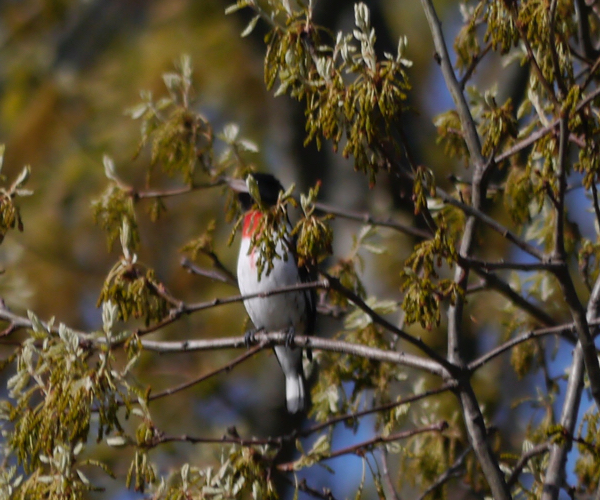
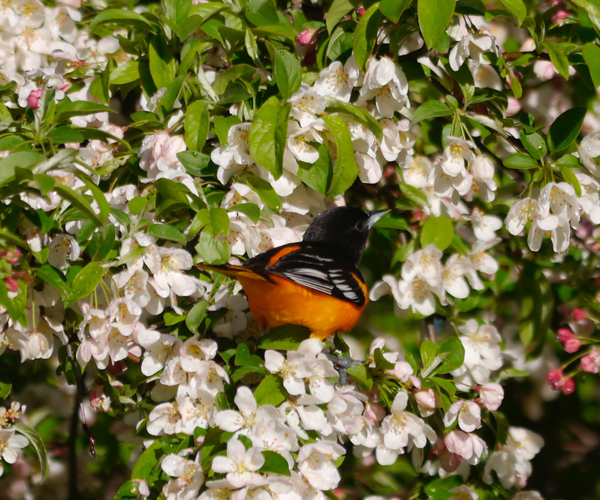
The grosbeak is the most exciting, I think, because there have been many years when we didn’t see any of them. We saw a lot of them last year on our walks around Nahanton Park and were hoping we had learned how to find them. Maybe we have!
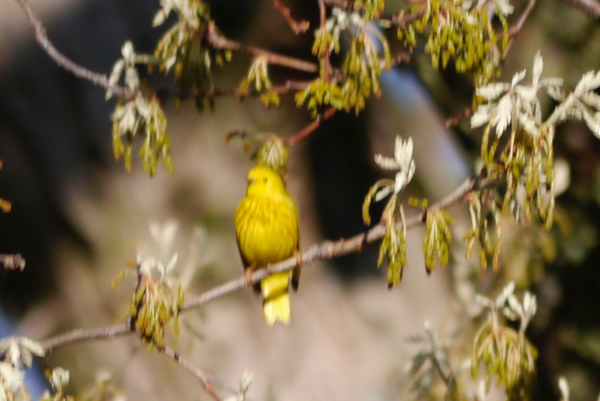
Yesterday we saw a black-and-white warbler, yellow-rumped warbler, and yellow warbler and got good long looks at palm warblers. Today was less good for warblers, but I did get a (not awfully good) picture of a yellow:
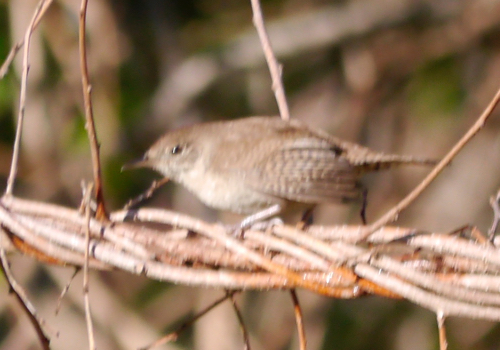
… and this house wren looks very much as though he wishes I hadn’t seen him:
The grandkids were at our house for about an hour after school today. We picked them up at school and took them to their house first. While Maija attended a food science class over the computer, we were keeping Ari busy in their backyard with riding toys and a kids play tent that we just barely got set up before Maija’s class was over and it was time to go back to our house. Ari found “Flight of the Jacquins”, a board game about characters from the Disney series Elena of Avalor that we had played before the pandemic. We set it up and he and I played it, not necessarily according to the rules. It’s a case of “oh yes, I remember that we had that toy, let’s use it for five minutes and see what else is here that I haven’t thought about in a year.”
Pileated on the Strawberry Patch
That’s a “the title says it all” situation. Arlene looked out the window and said, “There’s a bird on the raised bed. I think it’s a pileated!” We got binoculars and took a closer look. It was. We got out our phone cameras and opened the front door quietly and took pictures. Arlene walked closer while I took a fifteen-second video of it hopping behind a tree forty feet away from me. It flew, but not far. I was watching more on the camera video screen than in real life, and lost sight of it when it landed and folded up its wings, hiding the big white spots — it’s the way you follow the white tail of a running deer, and lose sight of it when it drops the tail — but it was right there on the tree ahead of me.
Maine Pottery Tour
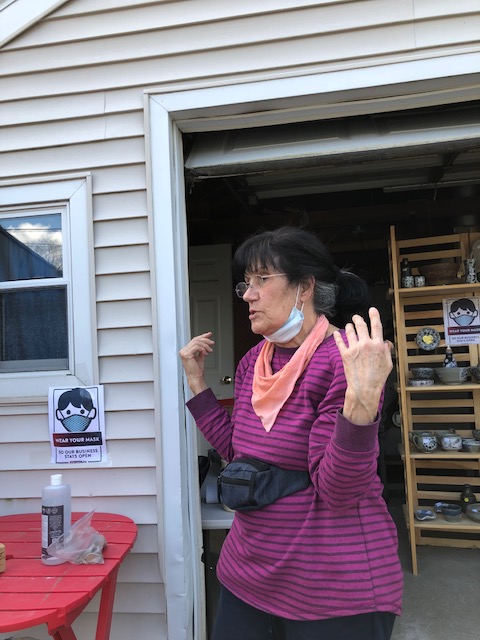
We didn’t really get as early a start as we had hoped, but we set off today to see some of the Maine Pottery Tour, sort of a statewide open studio event for potters and ceramic artists. Part of the goal was just to visit one of the potters, a former Newton art teacher who is still a good friend of Arlene’s.
We got on the Maine Turnpike in Auburn and headed north, planning to start with the farthest from home of several pottery tour venues that we had selected, all more or less in the Augusta area.
Our first stop from home was the West Gardiner rest area of the turnpike, because it’s far enough to be a logical pit stop and because it has a tourist information desk. The info desk is inside a beautiful store selling Maine-made crafts which are always fun to look at, but we kept focused and just got directions to our first pottery stop, Maple Lane Farm in Windsor, near the fairgrounds that the Maine Fiber Frolic had been at years ago, a dozen miles east of downtown Augusta.
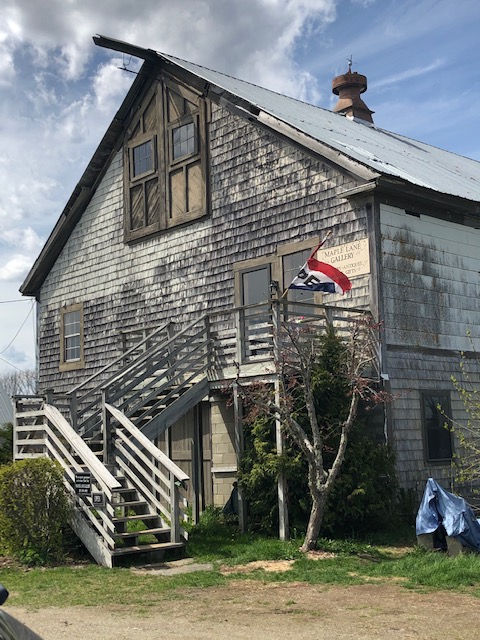
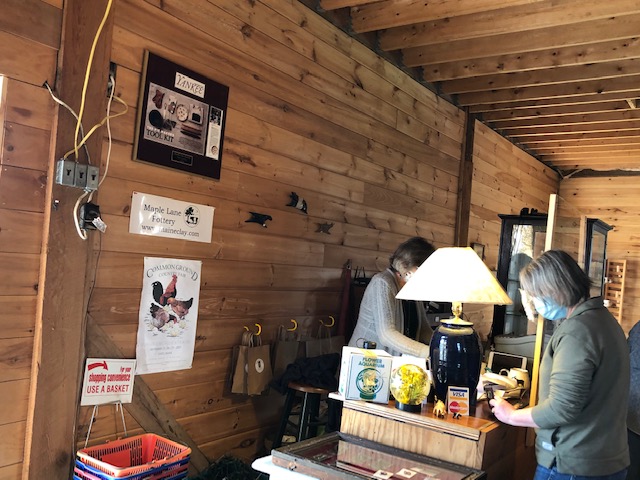
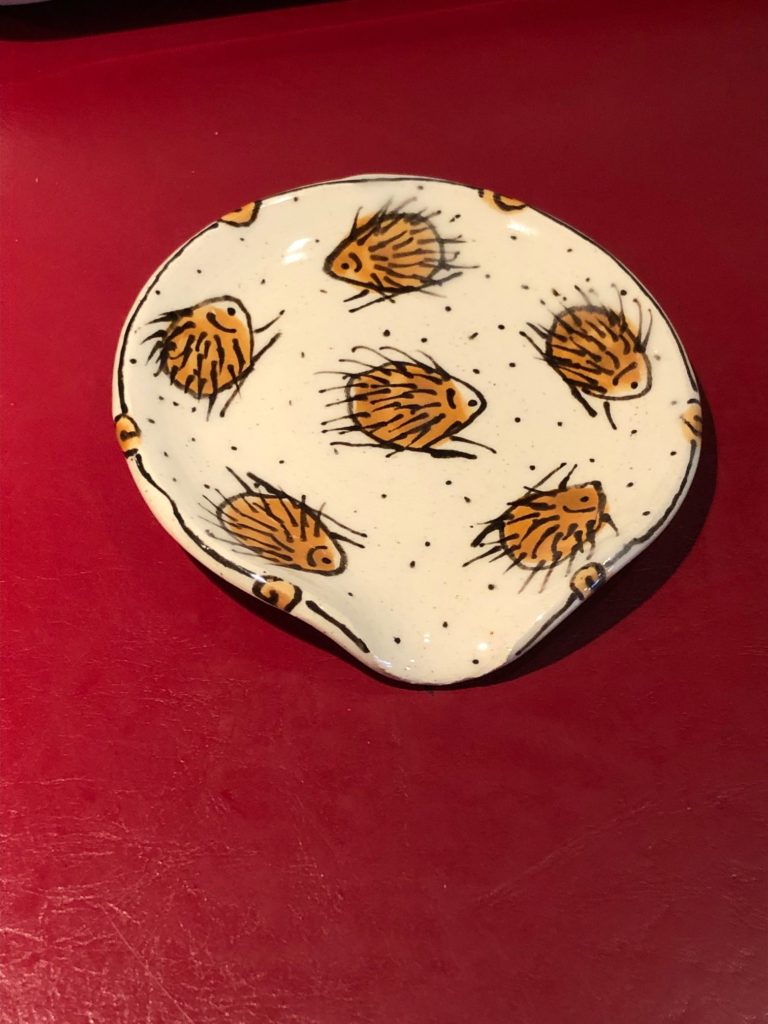
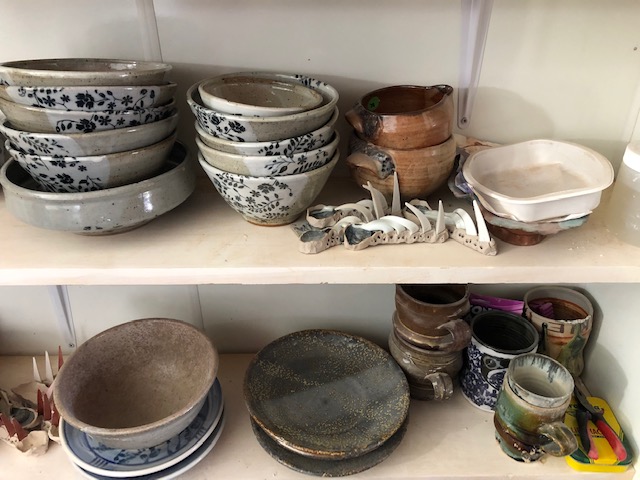
The first thing I noticed was that the woman who greeted us was wearing a mask that looked just like some of the designs on her pottery! She told us that it was indeed a custom fabric from Spoonflower — maybe I want to design some fabric! The space in the top of that barn is not a workshop or studio but a big showroom, with a table set with plates and cups that she made, and lots of display shelves showing the wares, which include handmade knick knacks and postcards as well as plates, bowls, mugs, spoon rests, sponge rests, garlic graters…
From there we went to Whitefield Pottery, a much different feel — a tent (or pop-up crafts show canopy) over a table of embarassingly affordable “seconds” that we couldn’t see anything wrong with, and a couple more tables set up outdoors and in a small workspace with an electric potters wheel and a kiln. Here’s the top of the kiln and some typical pieces of hers:
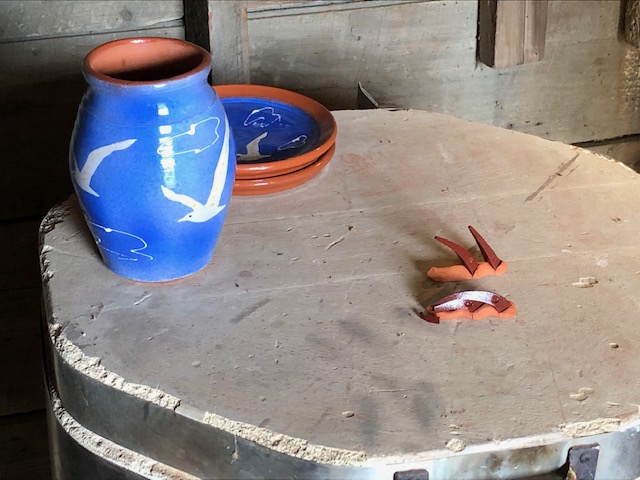
If you haven’t done pottery, you may be wondering about those tall pyramid thingys in the front foreground. Those are called pyrometric cones. If you think pyro = fire, metric = measuring something you’re right. When you fire a kiln, you need to get it hot enough to turn the clay into pottery, otherwise it will just turn back into mud when it gets wet. That means hot enough that the microscopic particles of clay start to melt into each other. But get it too hot, and the whole piece will melt into a lump of dirty glass. So ceramists have developed a series of materials that melt at different temperatures. Those lumps of clay holding the pyramids are holding two cones, one of which will start to bend over at the temperature that is right for the particular kind of clay the potter is using at the time. The two cones in the foreground look as though they may have been overfired. The potter looks (with proper eye protection!) through a peephole into the hot kiln every so often to check the cones to know when the firing is complete. Many modern electric kilns have electronic temperature sensors and automatic temperature control.
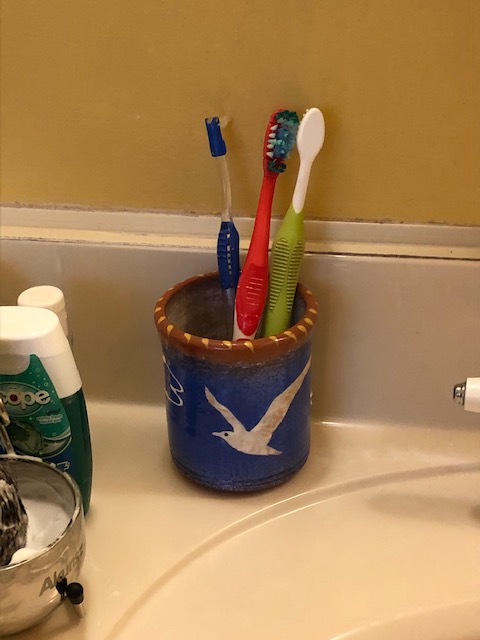
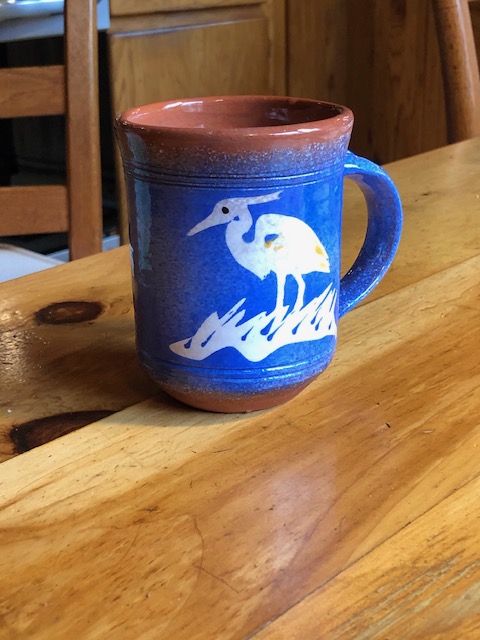
I got a mug with a heron or egret design on it and we got a cup to keep toothbrushes in. We talked for a while with the artist about why she had put the pots which looked beautiful to us on the “seconds” table, and about a big tree behind the house which had recently been cut down.
Heading back into Augusta we stopped at a place we had been to on the pottery tour three years ago, Fine Mess Pottery. I remembered this studio distinctly, with an old bicycle mounted for decoration above the door to the kiln shed. I think we have three little (I mean, four inch high!) vases from her in Newton. This year she had a seconds table with pots that looked good to us for $5.
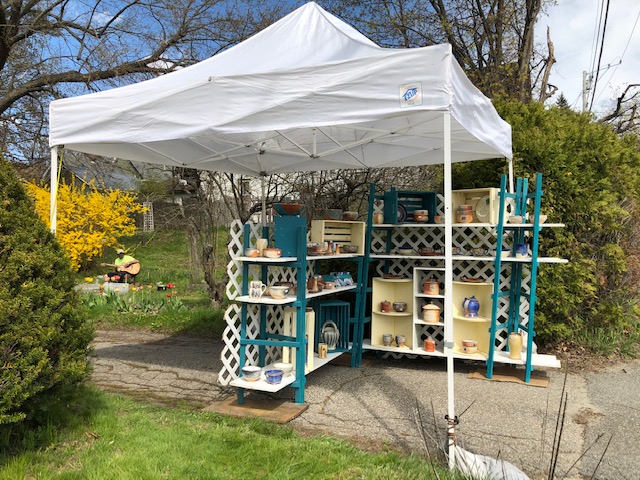
Last stop was Arlene’s friend Marie’s Red Door Pottery in Augusta. Marie used to be an art teacher in Newton. She let us stay in her condo in Old Port, Portland ME, for a week once in the mid-90s and again later, at which time she was living near a lake north of Bangor. We drove out to visit her there and stayed overnight because our car broke down on the way, we got there much later than we expected, and we didn’t want to drive back and maybe get stuck on the way back in the middle of the night. A memorable part of that trip was watching someone else who lived on that lake fire his potato cannon over the water — it was a homemade device made of PVC pipe that he would push into a potato to make a tight-fitting plug, shoot some butane into, and create a spark inside; the explosion would propel the potato piece hundreds of yards out over the lake. But I digress. Those stays in Marie’s condo were really the start of our loving Maine (and certainly of knowing our way around that part of Portland.) On our way home from the Nature Printing Society workshop at College of the Atlantic in Bar Harbor in 2007 we visited Marie on Deer Isle, not far from the Haystack Mountain School of Crafts, where she was then living. We last saw her three years ago in Augusta when she was participating in the pottery tour.
Good Palm Warbler Day
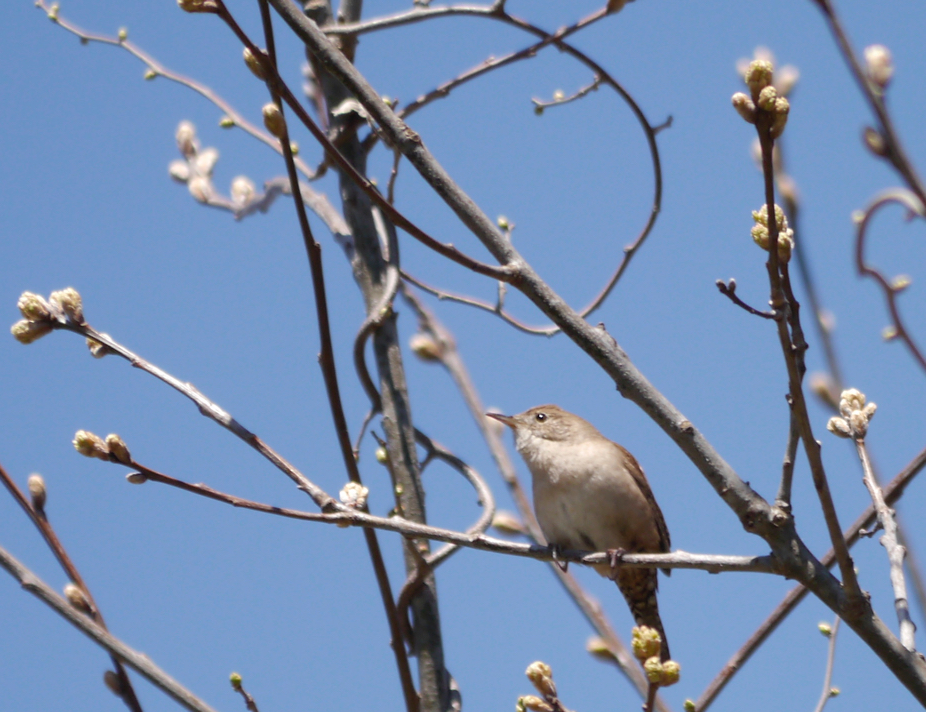
We went out to Nahanton Park pretty late (around 11!) this morning. The bluebirds were nowhere to be seen, but we did hear and see a house wren, first of year, behind the lower garden plots.
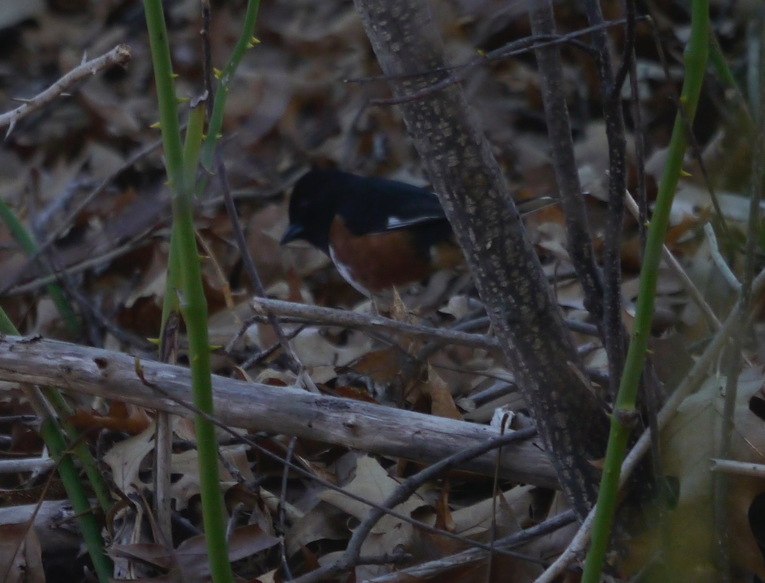
In the brush just off the path along the soccer field there was a towhee, which should not be a rarity but is something I have only seen a couple of times in the last decade.
Even better were good looks at four palm warblers near the path along the Charles. We had seen one a week or ten days ago, but these were more cooperative. Also noteworthy, a ruby-crowned kinglet.
I was on the phone with our car salesman and the insurance company, trying to get the right fax number for the salesman to get the registration information for our new car to the insurance people. It’s unresolved at the moment.
I carved an eraser stamp of, you know the kind of image, a personification of “wind”, a cloud with a face, blowing a breeze. I’ll come back here and post the picture eventually but not until a postcard with it gets to the addressee. However, I can say that I’m pleased that I drew it entirely without looking at any similar image, and I like the way it came out.
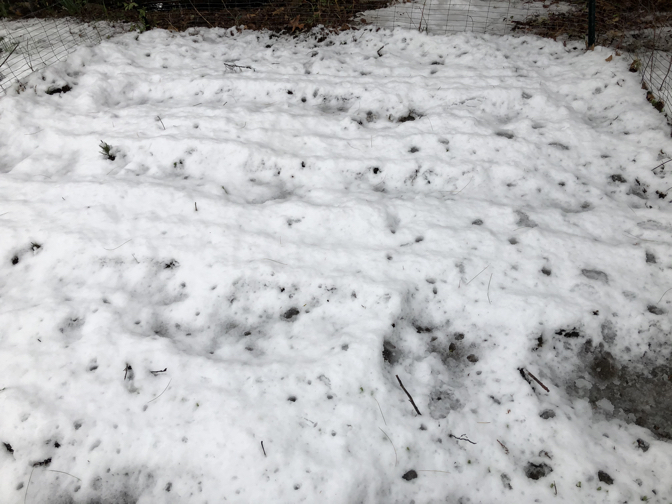
Snowy April 16
Arlene went to the endodontist for a root canal today. I went to the CVS to fill her antibiotic prescription, and to Whole Foods to get her some yoghurt and bananas, and potatoes and codfish to make fish chowder for low-chewing dinner.
The weather forecast had predicted rain today and snow for farther west and north, but around 11:30 we noticed that it was snowing outside. By the time I was home from the errands there was more than a dusting of snow. This is not the latest in the season we’ve had snow, but it’s one of only a few times we’ve had any this late in the Boston area.

Bluebirds at Nahanton Park
We got up at 6 AM, had coffee, and were at Nahanton Park by 6:35 to look for birds. We expect to keep that kind of hours frequently for the next five or six weeks, until spring migration is over. Arlene has seen reports of palm warblers in Maine, so she thought there could be some in Newton too.
Almost as soon as we got out of the car we saw a bluebird sitting on a birdhouse.
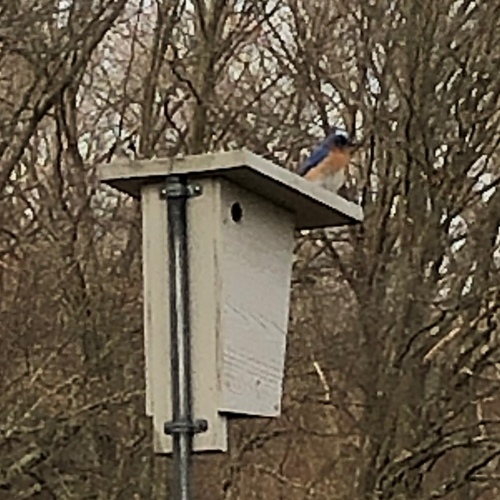
Bluebirds were really hard to find in Massachusetts when we started birding. They have become much more common again, but they’re not an everyday occurrence. We used to see more of them at Nahanton Park than we have in recent years, but we did see them this past autumn in Millennium Park, a few miles upstream along the Charles in Boston (“Wait, I thought Boston was downstream from Newton!” Yes, downtown Boston is, but West Roxbury is upstream. The Charles goes three quarters of the way around Newton, and the river is the boundary between Boston and Dedham after it gets past Newton.) Some years the bluebirds are only in Nahanton Park at the very start of Spring, and either move away or are successful at hiding later; so some years we see them and some years we don’t.
We continued around garden plots…
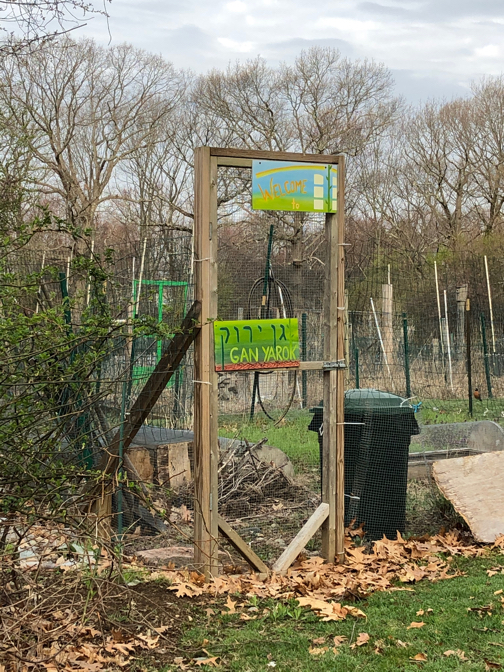
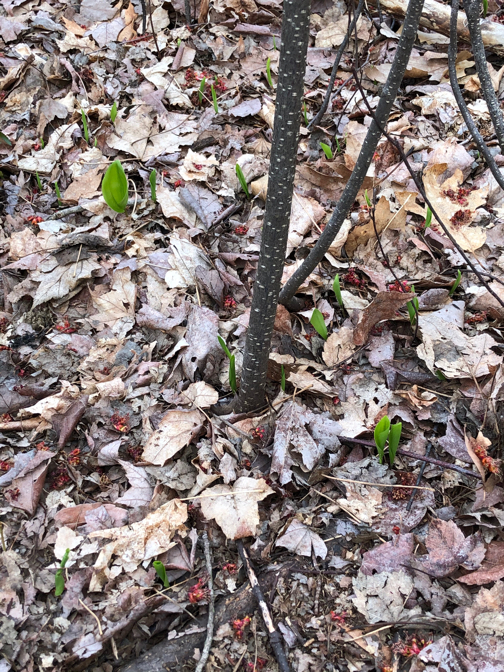
not seeing or hearing much else (except for female red winged blackbirds — we’ve been seeing males, but I’m not sure about females), and continued past the soccer field. We were hearing a Carolina wren, but couldn’t find it. I think Carolina wrens have the loudest call for their weight of all birds we have around here, and it could have been farther away than it sounded. I saw a splash near the far end of the pond to the right of the path, put up my binoculars, and saw an animal swimming. We’re convinced that it was a beaver — it looked much bigger than a muskrat, and seemed to have a broad tail. There wasn’t much to see along the river. Arlene pointed out some Canada mayflower coming up along the trail coming back from the river.
I saw a small bird that didn’t look the same color of gray as a chickadee, more yellowish. I called it to Arlene’s attention and she got a better look than I did. It was a palm warbler, which is usually one of the first warblers to arrive in spring. That and the bluebird made it a really good start to migration birding.
We went out to Metrowest Subaru and ordered a new Forester. The old one has 214,000 miles on it and needs expensive work on its air conditioning and a new head gasket — too much money to put into a car that old, and we want the new safety features like lane departure and blind spot detection; the old one doesn’t even have a backup camera.
End of the School Day
We picked the grandkids up at school and went to the park with them. At their elementary school, at least in the lower grades, parents (or other caregivers) wait on one section of the schoolyard and classes come out one at a time. Kids look for their parents, tell their teacher, “there’s my (–)”, the teacher dismisses them one at a time, and the kid runs to their grownup, backpack bouncing.
We brought some flying toys to the park: a balsa airplane, whirligig propeller toy (one of those sticks with a propeller attached to the top, that you fly by spinning the stick between your hands), and a flying ring called an aerobie which you throw sort of like a frisbee. It’s a precision designed circular wing and can fly a great distance if thrown expertly. We’re not experts, but Ari was getting it to travel over fifty feet after several tries.
Kids are amazing with each other. Grownups can be hesitant to talk to each other, but with kids it’s “Hi I’m Maija, what’s your name?” “xx” “Great! Now we’re friends!”
I used the stopwatch on my phone to time those kids running a lap around the woodchip-covered playground area, and to see how fast they climbed up and slid down. I think the kids liked the attention.
Ari did the tunnel slide, hesitantly at first, then confidently by the time we left.
Pequosette Park in Belmont has been rethought since we were there. There is lots of new play equipment including 3 places to play “cafe” or “tollbooth” or “farmer’s market”
Caging the Hazels
I had worried about deer eating my new hazel plants in the middle of the night. I’m not sure I lost significant sleep about it, but it was a concern. In the morning I lugged a roll of fence wire up to where I had planted them and put wire cages around them. It wouldn’t stop a determined deer, but the idea is to make the hazels a little less attractive than other vegetation nearby.
I made a second trip with garden staples and a bucket of water, stapled the cages into the ground, and gave four of the hazels a drink.
Made another 2 trips with buckets of water and got all the bushes evenly watered.
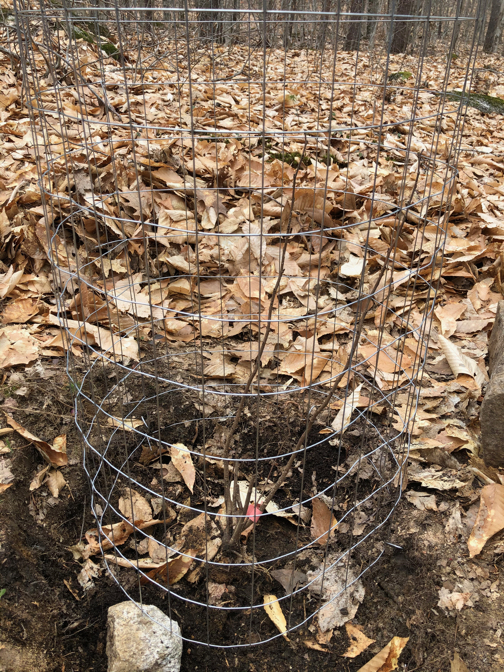
My pedometer app said it was a total of 2 miles walking; probably as much was back and forth in the hazel patch as from the house to the patch.
We drove home just in time for supper. Arlene and I watched a zoom interview sponsored by Friends of the Shakers. The panelists were Brother Arnold, one of the few remaining Shakers, and a woman who had just written a book about a girl raised by the Shakers. Brother Arnold knows more Shaker history than anyone else now alive, I think, and was able to reassure the author that many details of her story (like everyone breaking into song in the middle of doing the community laundry) were indeed plausible. I left a few minutes early to go to my Symphonic Band zoom meeting.
Pick and Shovel
I dug the last two holes for the five hazel trees that I have to plant. One of them had several stones that just don’t look natural; they have square corners and flat sides that look as though someone dressed them for building with. It felt as though I was digging up part of a foundation, but I didn’t go far enough to see if the stones were in a line. A couple of years ago I bought a smallish, light but strong pick-mattock. The pick seems to be able to find the edge of rocks and get around them in a way that a shovel can’t. I have been finding it much easier to dig holes in what passes for ground in Maine with it than just with a shovel; the pick loosens the material, including rocks, and then I can shovel the loose material out.
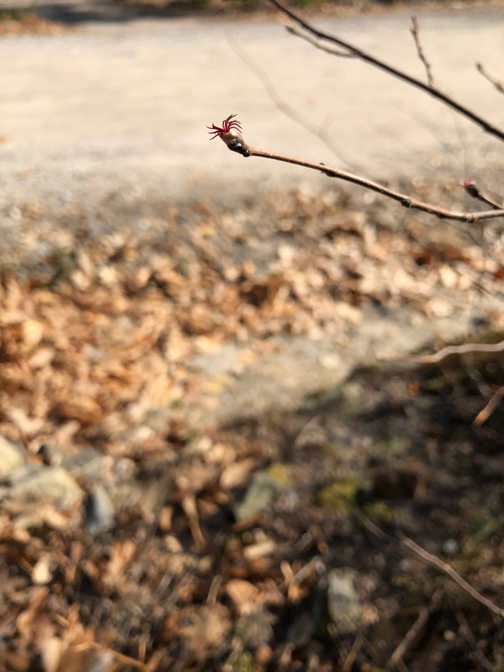
I planted the five hazels, putting half a bag of the compost we got at Smedberg’s the previous day in each hole. I hope it’s not too strong for the plants, but I think they can use better soil than is out there in the woods.
I grafted a three more apple trees, bringing total to nine. The roots are sitting in wet newspaper for the time being.